Two acne patch formats dominate private label production in 2026. They look similar on a retail shelf but they have wildly different unit economics, target customers, and shelf velocity. Here's how to pick the one that matches your brand.
Almost every skincare brand considering an acne SKU ends up choosing between two formats: hydrocolloid dots and dissolving microneedle patches. They both look like small circles stuck to a face. They both claim to treat breakouts. But the way they work, what they cost, and who buys them are completely different — and the wrong choice kills the SKU's economics before it ships.
How they actually work
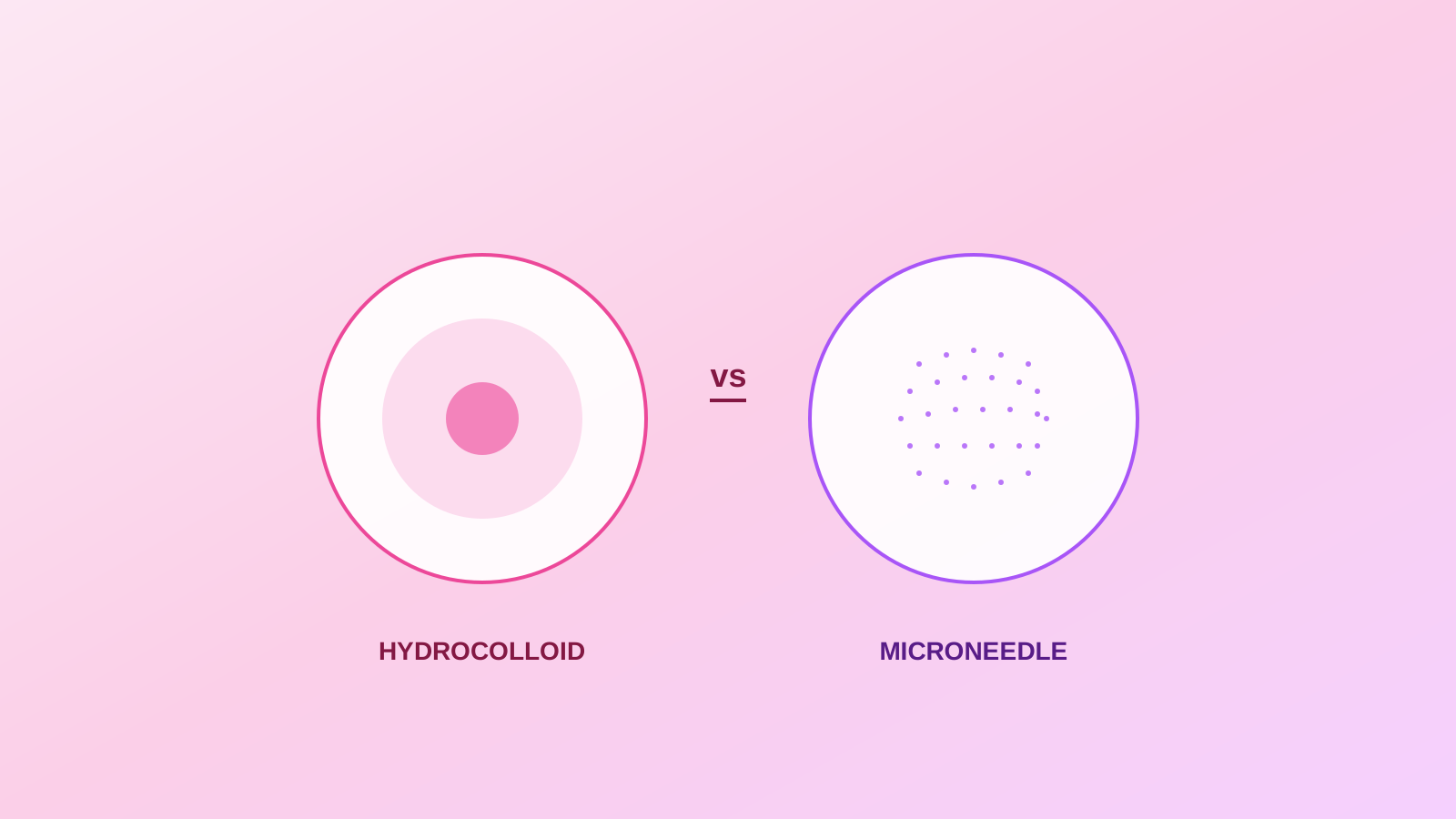
Hydrocolloid patches are made of a gel-like substrate that absorbs fluid. Applied over a whitehead or inflamed spot, the patch pulls exudate out and creates a moist, sealed environment that speeds surface-level healing. It's a passive treatment — the patch absorbs what the skin is already ejecting.
Microneedle patches have hundreds of tiny dissolving needles (usually hyaluronic acid-based) that penetrate the stratum corneum and deliver actives — salicylic acid, niacinamide, peptides — directly into the upper dermis. It's an active treatment, designed to reach deeper spots that never reach the surface.
The mechanism difference explains every downstream trade-off.
Who the target customer is
| Customer profile | Format |
|---|---|
| Teen / young adult dealing with regular whiteheads | Hydrocolloid |
| Gen Z buying on TikTok, wants visible "gross" result | Hydrocolloid (the white saturated dot is the point) |
| 25–40 with occasional stubborn cystic spots | Microneedle |
| Premium skincare consumer, $25+ MSRP | Microneedle |
| Mass retail channel, <$10 price point | Hydrocolloid |
| Clinical / dermatology-adjacent positioning | Microneedle |
Hydrocolloid is a volume game. Microneedle is a premium game. Brands that mix up the positioning — microneedle at drugstore prices, hydrocolloid at $30 — underperform on both.
Unit economics and MOQ
This is where the decision becomes financial, not aesthetic.
Hydrocolloid
- Landed unit cost (at 5K MOQ): $0.15–$0.35 per patch depending on size and format
- Typical retail price: $8–$14 for a 24–36 patch box
- Gross margin at DTC: 60–75%
- MOQ: 3,000 boxes easily achievable
- Shelf life: 36 months
Microneedle
- Landed unit cost (at 5K MOQ): $0.80–$1.80 per patch
- Typical retail price: $25–$60 for a 4–8 patch box
- Gross margin at DTC: 55–70% (higher unit cost offsets some price premium)
- MOQ: 5,000–10,000 boxes
- Shelf life: 24 months
Microneedle looks like it has worse unit economics in raw terms, but the smaller pack size and higher MSRP mean dollar-per-box revenue is often higher than hydrocolloid. The category is also less price-competitive on Amazon because there are fewer players.
Production lead times and complications
| Factor | Hydrocolloid | Microneedle |
|---|---|---|
| Sampling time | 2–3 weeks | 4–6 weeks |
| First-order production | 30 days | 45–60 days |
| Stability data available | Often ready off-shelf | Typically SKU-specific |
| Compliance complexity | Low (cosmetic or device class I) | Medium (device if delivering actives) |
| Shipping constraints | Robust | Temperature-sensitive in hot climates |
Microneedle adds roughly 30 days to time-to-first-shipment and adds temperature control to your logistics. Both are solvable — neither is free.
Marketing claims that each format supports
Hydrocolloid claims that hold up:
- "Absorbs pimple fluid"
- "Protects the spot from picking"
- "Creates a moist healing environment"
- "Reduces spot visibility"
Hydrocolloid claims that DON'T hold up:
- "Penetrates deep into the skin"
- "Delivers actives into the dermis"
Microneedle claims that hold up:
- "Delivers actives below the surface"
- "Dissolves on contact with skin"
- "Works on under-the-skin spots"
Microneedle claims that DON'T hold up (without OTC path in the US):
- "Treats acne" (drug claim — needs the OTC path)
- "Heals cystic acne overnight"
How to choose — in priority order
- What's your retail price? Under $15 → hydrocolloid. Over $20 → microneedle is defensible. $15–$20 is a dead zone where neither format wins.
- What's your channel? Mass retail / drugstore / Amazon volume → hydrocolloid. DTC / Sephora-style / dermatology-adjacent → microneedle.
- What's your brand story? "Fun, visible, routine" → hydrocolloid. "Clinical, targeted, premium" → microneedle.
- What's your cash ceiling for first order? Under $15K → hydrocolloid at 3K MOQ. Over $30K → microneedle at 5K MOQ becomes workable.
The pragmatic answer for most new brands
Start with hydrocolloid for your first acne SKU. Add a microneedle SKU six months in as a premium-tier line extension once you have DTC customers who trust you enough to pay $30+. This is also how you avoid the "we launched a premium microneedle product and can't find customers" trap that hits 1 in 3 first-time acne brands.
If you want a sample kit with both formats on the same base formula, we ship side-by-side samples within five business days.
Planning a launch like this?
Our team can scope sampling, compliance, and packaging in a single reply. Typical response time is one business day.
Get in touch