Selling skincare on Amazon US without a pre-launch compliance dossier is how brands end up delisted 60 days after their first review spike. This is the checklist we run with every US-bound private label brand.
Amazon is the most forgiving storefront to launch on — right up until it isn't. The platform won't audit your paperwork when you list. It audits when a customer complains, when a competitor reports you, or when your sales cross a threshold that flags you for review. At that point you have 48–72 hours to produce a complete compliance dossier, or your listing disappears. This guide is the pre-launch checklist we run with every US-bound skincare brand so that 48-hour window is never scary.
Step 1: classify your product correctly
The first decision determines the entire compliance path: is your SKU a cosmetic, an OTC drug, or something in between?
| Product | US classification | Documentation path |
|---|---|---|
| Hydrating sheet mask | Cosmetic | Cosmetic path |
| Hydrocolloid pimple patch (no actives) | Medical device, class I | Device path |
| Salicylic acid acne patch | OTC drug (monograph) | OTC drug path |
| Sunscreen | OTC drug (monograph) | OTC drug path |
| Anti-aging serum with retinol | Cosmetic (if no drug claim) | Cosmetic path |
| Peroxide-based whitening | OTC drug | OTC drug path |
Misclassifying is the single most common pre-launch mistake. A salicylic acid patch marketed with "clears breakouts" is an OTC drug in the US, not a cosmetic — and it needs a completely different dossier.
Step 2: facility and product registration
For cosmetic SKUs:
- Facility registration with FDA under MoCRA (the Modernization of Cosmetics Regulation Act)
- Product listing with FDA — every cosmetic SKU individually, updated annually
- Responsible person designated
For OTC drug SKUs:
- Manufacturing facility registration and drug listing with FDA
- NDC (National Drug Code) assigned to each SKU
- Compliance with the relevant OTC monograph (acne, sunscreen, antiperspirant, etc.)
For medical device SKUs (device-only pimple patches):
- Establishment registration with FDA CDRH
- Device listing per product
- Quality System (21 CFR 820) for higher classes
Step 3: labelling that passes an audit
Amazon's auditors read labels. Everything on your product has to pass these three tests:
- Identity — consumers can tell what it is
- Net quantity — on the principal display panel
- Claims — every claim substantiated by testing you can produce
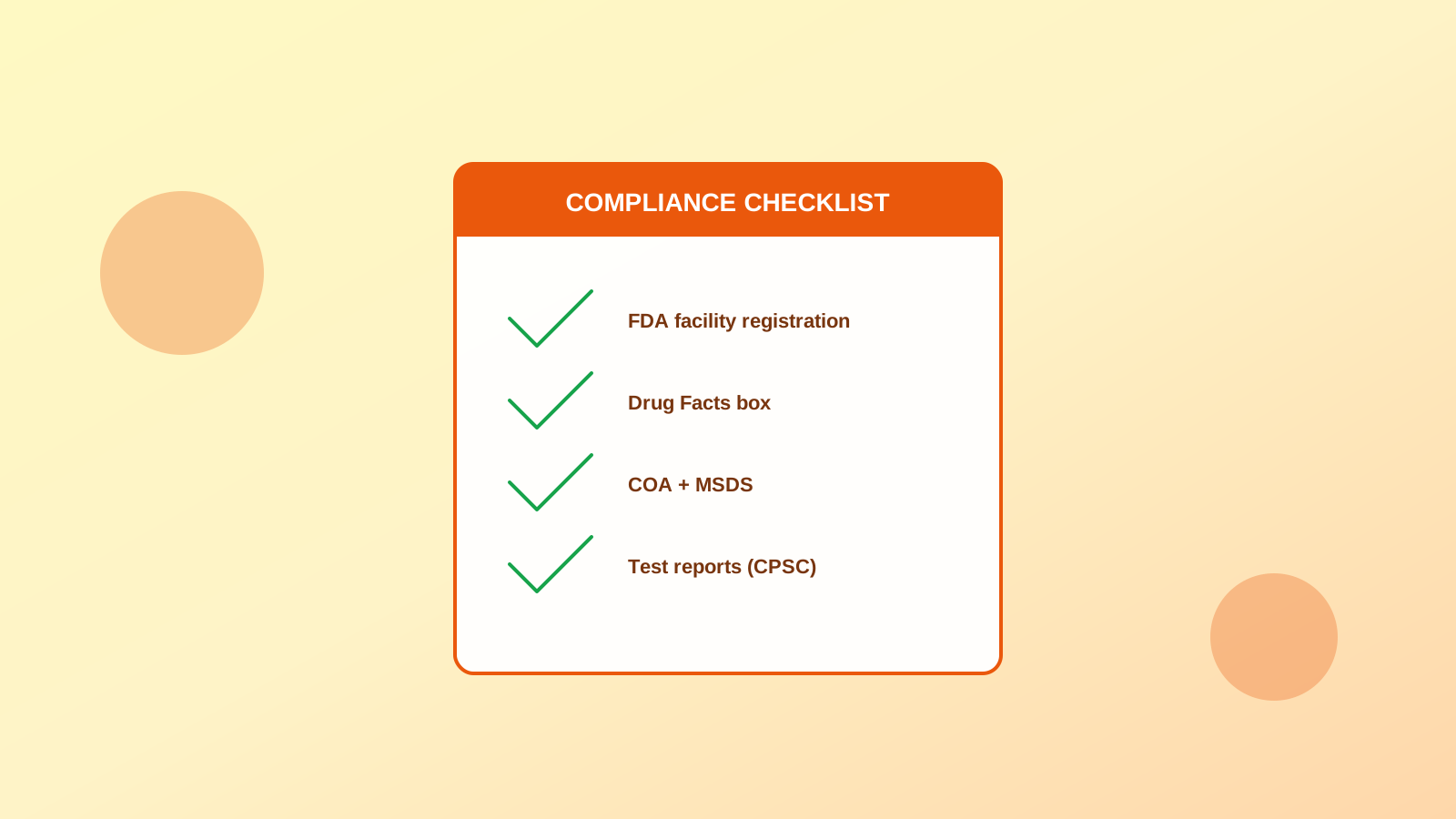
Labels for OTC drug SKUs must carry a Drug Facts box in the exact format 21 CFR 201.66 specifies. This isn't a stylistic preference — it's mandatory, and it's one of the fastest ways a listing gets pulled.
Common claims and what they actually require:
- "Clinically tested" — need an actual clinical study on file (not an ingredient study)
- "Dermatologist tested" — need a dermatologist-supervised test
- "Hypoallergenic" — need allergen testing data
- "FDA approved" — never use this for cosmetics; FDA does not approve cosmetics
- "Paraben-free" / "Sulfate-free" — safe to use if true
Step 4: the dossier Amazon wants to see
When Amazon (or the FDA) asks, these are the documents you need to produce within 48 hours:
- Certificate of Analysis (COA) tied to the lot number the customer received
- Material Safety Data Sheet (MSDS / SDS)
- Stability test summary (minimum 90-day accelerated testing)
- Microbiology test results (PET, USP <51>)
- Ingredient list with CAS numbers
- Manufacturing facility FDA registration confirmation
- For OTC: monograph compliance statement
- For device: 510(k) clearance if required, otherwise classification rationale
- Substantiation for every claim on the label
- Product Information File (PIF) or equivalent
The non-negotiable move: request all ten documents from your manufacturer at the time of your first purchase order. Do not wait until launch. Do not wait until Amazon asks.
Step 5: Amazon-specific listing requirements
Amazon layers its own rules on top of FDA rules:
- Category approval — beauty and personal care require pre-approval for some subcategories (children's, sunscreen, acne)
- Branded product registry — enrol in Brand Registry with your USPTO trademark for counterfeit protection
- Listing images — must show the product clearly with claims legible
- Product inserts — can't promise discounts for 5-star reviews (this is also FTC territory)
Step 6: post-launch — what to watch
The first 30 days after launch are when compliance issues surface. Three alerts to set up:
- Customer complaint monitoring — track every 1-star and 2-star review for safety mentions (rash, burn, allergic reaction)
- Adverse event reporting — MoCRA requires you to report serious adverse events to FDA within 15 business days
- Listing content drift — Amazon sometimes auto-edits your listing. Review your live listing weekly for the first month
The pre-launch audit we recommend
Before your first US shipment, run this checklist against your dossier:
- Correct classification (cosmetic / OTC / device) confirmed in writing
- All FDA registrations active and listed
- Drug Facts box on OTC SKUs reviewed by a regulatory consultant
- All 10 documents above on file at your manufacturer, with copies in your own drive
- Claim substantiation backed by test reports — not marketing decks
- Amazon category pre-approval in hand where required
- Brand Registry enrolment confirmed
- Post-launch monitoring set up
If your manufacturer can produce the full ten-document set on a single email, you're in excellent shape. If they can't, that's the gap to close before you ship.
Our compliance team reviews US dossiers for new clients before every first production run. Send us your current document set and we'll flag the gaps inside one business day.
Planning a launch like this?
Our team can scope sampling, compliance, and packaging in a single reply. Typical response time is one business day.
Get in touch